What you need to know now about the cost of living in Lehi, Utah
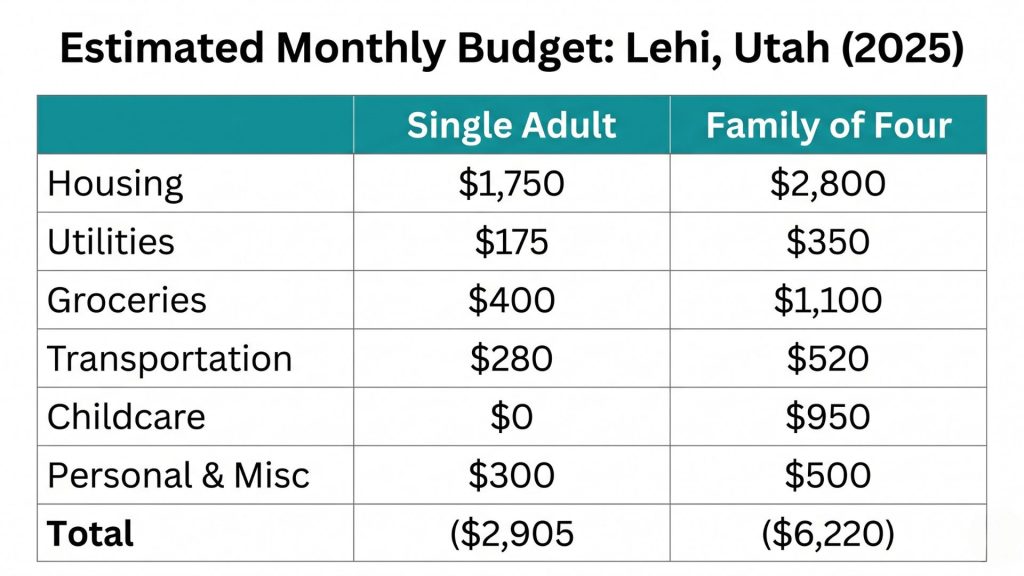
- The Bottom Line: Expect to pay between 8% and 12% above the national average, with total monthly expenses ranging from $2,500 for individuals to $7,200 for a family of four.
- Housing Reality: Median home values are hovering near $590,000, but I’ve found that new construction in Lehi often offers better long-term value than buying a 1980s resale that needs $100k in repairs.
- The Income Threshold: You’ll want a household income of at least $110,000 to $130,000 to live comfortably here without feeling in the shadow of the tech giants.
Keep reading to see the line-by-line breakdown of where your money actually goes when you move to the Slopes.
How Does Lehi’s Cost of Living Compare to the National Average?
Lehi’s overall cost of living runs about 8 to 12 percent above the U.S. national average, driven almost entirely by housing. Remove housing from the equation, and day-to-day expenses in Lehi track close to the national midpoint.
The city’s median household income of $131,000 (U.S. Census Bureau, 2023) gives most families real headroom but that income figure reflects a workforce heavily weighted toward tech.
Not every new resident will start at that number.
What Does Housing Cost in Lehi, Utah?
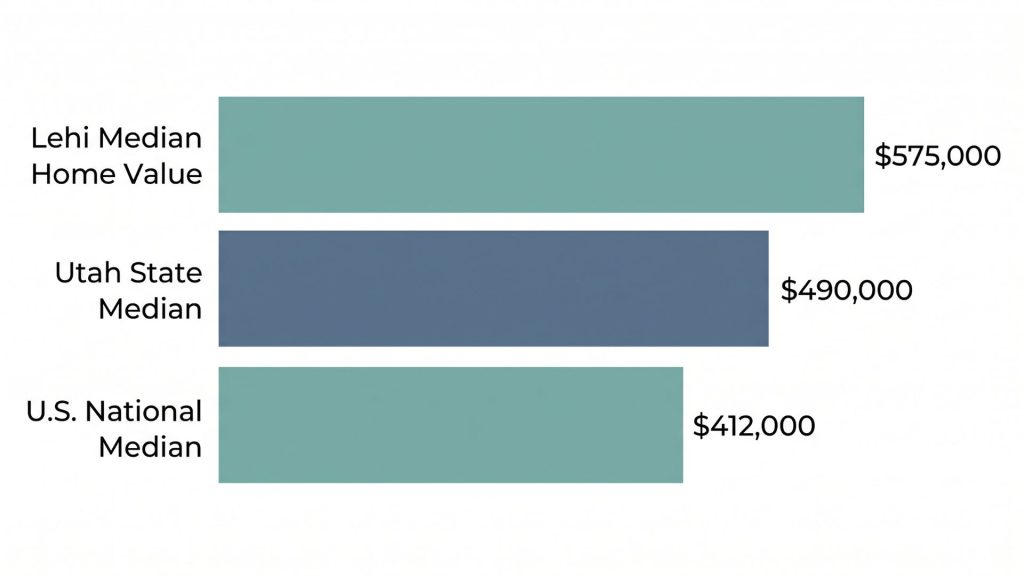
Housing is the number that changes everything in Lehi. Median home values sit around $560,000 to $590,000 as of early 2026. That is down from the 2022 peak but still roughly 40 percent above the national median.
For buyers comparing Lehi to Salt Lake City proper, new construction in Lehi often wins on value. You are getting a home built to 2024 energy codes rather than a 1970s resale with unknown systems.
New Construction vs. Resale: What the Price Gap Actually Looks Like
New construction in Lehi typically runs $420,000 to $650,000 depending on square footage and community.
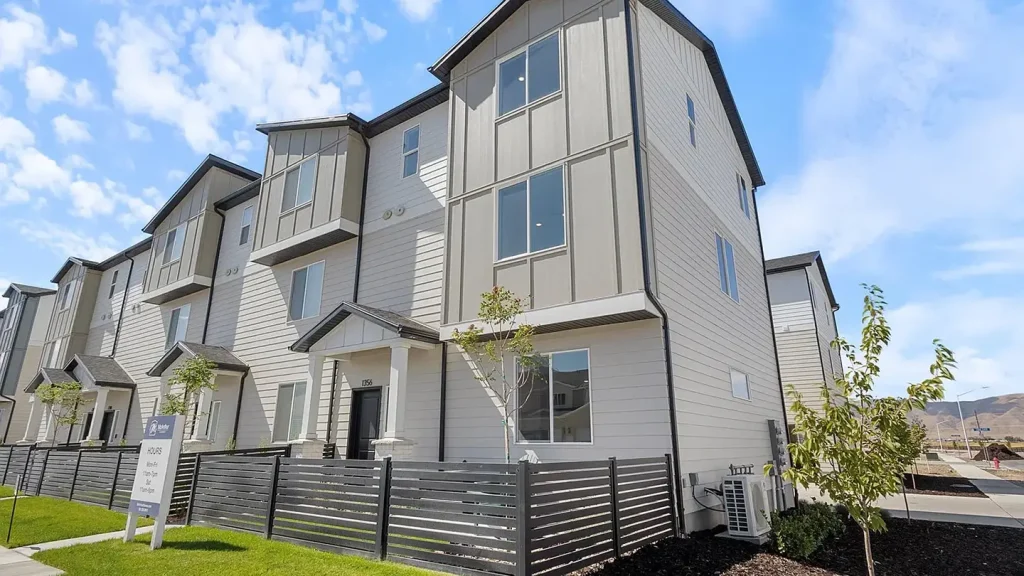
Townhomes in communities like Arrowhead Ranch start lower, giving first-time buyers a realistic entry point.
Single-family homes in planned communities start in the low-to-mid $500s.
Resale homes can list lower on paper. Factor in deferred maintenance, older mechanicals, and the cost to bring the home up to current standards, and that gap narrows fast.
What About Renting in Lehi?
Rental rates in Lehi average $1,550 to $1,900 per month for a two-bedroom unit, based on current market data.
Three-bedroom units push $2,100 to $2,400.
For anyone doing the rent-vs-buy calculation, that monthly rent payment is close enough to a mortgage on a new home especially when builder financing programs are part of the conversation.
Buying vs. renting is one of the most common questions we hear from people relocating to Utah County. We broke down the numbers for new construction specifically. Why New Construction Homes Are Cheaper Than You Think →
What Are Utility Costs for a Lehi Home?
Monthly utility costs for a standard Lehi home run $290 to $420, depending on home size, season, and whether the home is new construction or older. Homes built to Utah’s current energy codes consistently land at the lower end of that range. Google Fiber is available in many newer Lehi neighborhoods, which changes the internet cost picture compared to older parts of the city.
| Utility | Monthly Average | Notes |
|---|---|---|
| Electric (Rocky Mountain Power) | $95 – $135 | Higher June through August for AC |
| Natural Gas (Dominion Energy Utah) | $45 – $110 | Spikes December through February |
| Water / Sewer / Garbage (City of Lehi) | $85 – $120 | Tiered by usage |
| Internet (Xfinity / Google Fiber) | $60 – $80 | Google Fiber available in newer communities |
| Total Monthly Estimate | $285 – $445 | New construction runs lower |
Natural gas in a Utah winter frequently exceeds $100 for larger homes. New construction built to current Utah energy code, including proper insulation, high-efficiency HVAC, and low-E windows, cuts that bill meaningfully.
Energy efficiency affects your monthly budget from day one. See how McArthur Homes builds for Utah’s climate. Energy Efficient Homes in Utah →
How Much Do Groceries and Dining Cost in Lehi?
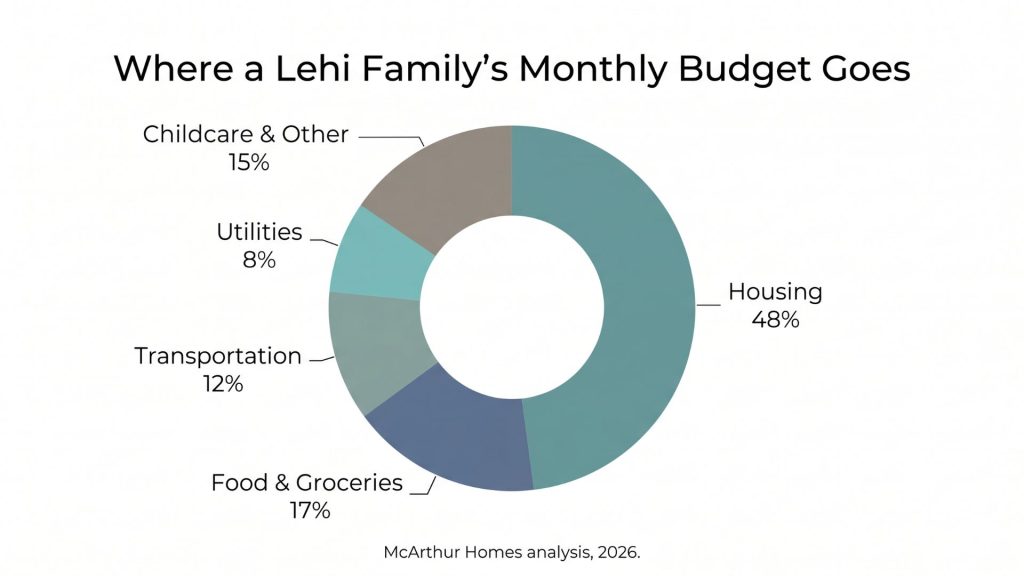
Grocery costs in Lehi track close to the Utah average, which runs about 5 to 8 percent below the national average according to the U.S. Bureau of Labor Statistics Consumer Expenditure Survey. A typical family of four spends $900 to $1,200 per month on groceries, depending on household size and preferences.
Lehi has a strong mix of grocery options. Smith’s, Walmart Supercenter, and Costco cover everyday staples. Sprouts and Harmons serve buyers who spend more on quality.
Dining out in Lehi has improved substantially. The Silicon Slopes workforce brought a real restaurant scene you’re not limited to chains. Average sit-down dinner for two runs $45 to $75. Fast casual is $12 to $18 per person.
What Does Transportation Cost in Lehi?

Lehi is a car-dependent city. Most neighborhoods score a Walk Score below 30. The Utah Transit Authority FrontRunner commuter rail has a Lehi station and connects north toward Salt Lake City and south toward Provo it is a real option for tech commuters. But it does not solve intra-city errands.
A monthly UTA all-system pass runs $173 as of 2026, covering FrontRunner, TRAX light rail, and bus service across the Wasatch Front.
For drivers, here is what a realistic monthly transportation budget looks like:
| Expense | Monthly Estimate | Notes |
|---|---|---|
| Gas (1 vehicle, avg. 1,000 miles/mo.) | $90 – $130 | Based on $3.50/gal Utah regular |
| Auto insurance (Utah avg.) | $110 – $160 | Higher for newer vehicles |
| Vehicle maintenance (amortized) | $60 – $100 | Tires, oil, registration |
| UTA Monthly Pass (if used) | $173 | Full-system Wasatch Front access |
| Single-car household total | $260 – $390 | Excludes car payment |
Many Lehi households run two vehicles. One commuter takes FrontRunner while the other parent handles school pickups and errands. That is a real cost most national cost-of-living calculators skip entirely.
What Does Childcare Cost in Lehi, Utah?
Childcare in Lehi runs lower than Salt Lake City but is still a meaningful monthly line item. Full-time daycare for children under two averages $1,100 to $1,400 per month. For toddlers and preschool-age children, costs drop to $700 to $950 monthly. Part-day preschool programs run $200 to $400.
Lehi’s public schools are a genuine asset. Alpine School District is the largest in Utah and one of the best-performing in the state. Elementary schools near newer McArthur communities have strong ratings, and the district has built new facilities to keep pace with Lehi’s growth.
Families moving to Lehi consistently tell us the community infrastructure surprised them most. Check out Family-Friendly Things to Do in the Lehi Area →
Is Lehi More Expensive Than Other Utah County Cities?
Lehi runs higher than Payson, Spanish Fork, and Springville on housing costs, but it is comparable to or below Orem, and well below the Draper and South Jordan corridor. The tradeoff is proximity to Silicon Slopes employers and newer infrastructure.
| City | Median Home Value (2026 est.) | Relative to Lehi |
|---|---|---|
| Lehi | ~$575,000 | Baseline |
| Draper | ~$680,000 | +18% |
| South Jordan | ~$625,000 | +9% |
| Orem | ~$510,000 | -11% |
| Payson | ~$415,000 | -28% |
| Springville | ~$435,000 | -24% |
Sources: Redfin local market data, Utah Association of Realtors 2026 estimates.
For families with flexibility on location, Payson and Springville offer real savings. McArthur Homes builds in both markets so buyers can compare communities and find the price point that fits.
The price difference between Lehi and surrounding cities makes more sense when you see what Lehi actually has to offer. Top 4 Reasons to Move to Lehi, UT →
How Much Do You Need to Earn to Live Comfortably in Lehi?
A single adult in Lehi needs roughly $60,000 to $70,000 in annual gross income to cover basic expenses without financial strain. A couple buying a home together in the $500,000 to $580,000 range is comfortably positioned with a combined household income of $110,000 to $130,000. A family of four with two children, one vehicle, and full-time childcare needs $130,000 to $150,000 to live without regularly stretching.
Lehi’s median household income of $131,000 sits right at that family threshold.
Explore McArthur communities across Utah County at multiple price points. View All New Homes →
What the Silicon Slopes Job Market Adds to the Picture
Lehi is at the center of Utah’s tech corridor. Adobe, Ancestry, and dozens of high-growth software companies are headquartered here or have major operations nearby. Utah County added more jobs per capita than any other county in the state in 2023.
That job density supports income levels that can sustain Lehi’s housing costs. It also keeps demand for housing high, which is part of why home values have not corrected the way some predicted after the 2022 peak.
How to Budget for Your First Year as a Lehi Homeowner
Moving into a new home in Lehi brings costs beyond the mortgage payment. Here is the sequence most buyers underestimate:
- Closing costs. Budget 2 to 4 percent of the purchase price. On a $550,000 home, that is $11,000 to $22,000 on top of your down payment.
- Utility setup. First month setup when switching providers can run $200 to $400.
- Landscaping and exterior. New construction homes often come with a landscaping allowance or HOA timeline requirement. Plan $3,000 to $8,000 in year one for sod, irrigation, and basic plantings.
- Window coverings. Almost never included in new construction. Budget $1,500 to $4,000 depending on home size.
- Appliances. Many new construction homes in Utah are sold without a refrigerator, and sometimes without a washer and dryer. Budget $2,000 to $5,000.
- HOA fees. McArthur communities include HOA coverage for exterior maintenance and community amenities. Confirm the monthly figure during the purchase process.
- Home warranty activation. New construction homes come with builder warranty coverage. Know exactly what is covered in year one versus years two through ten.
- Property tax proration. You may owe a partial year of property taxes at closing depending on timing.
First-time buyer in Utah? We walk through the full process from pre-approval to keys. First-Time Home Buyer in Utah →
What Hidden Costs Catch New Lehi Residents Off Guard?
Four things routinely surprise people in their first year:
Summer Water Bills
Utah summers are hot and dry. Lawn irrigation from June through September easily adds $80 to $150 per month to water bills. New construction homes with smart irrigation controllers help, but the climate is what it is.
The I-15 Commute to Salt Lake City
FrontRunner is a real option for northbound commuters. But if you are driving I-15 north from Lehi to Salt Lake during peak hours, budget 45 to 75 minutes each way on a heavy traffic day. Factor that into your daily life calculation, not just your housing cost.
HOA Rules Around Rentals
Some Lehi communities restrict short-term rentals. If you plan to use a room or the whole home for Airbnb, verify the CC&Rs before you close.
Earthquake Preparedness
Utah sits on the Wasatch Fault. Earthquake insurance is not typically included in standard homeowner’s policies. Annual earthquake coverage for a Lehi home runs $400 to $900 depending on coverage level and home value. New construction built to current International Building Code standards performs meaningfully better in seismic events than older homes.
Frequently Asked Questions: Cost of Living in Lehi, Utah
When you build new, you aren’t just paying for the lumber and labor; you’re buying into the city’s growth. Lehi charges specific impact fees for parks, public safety, and culinary water that can add several thousand dollars to your initial permit costs. While these are usually rolled into your construction loan, I always tell my clients to verify the current schedule with the city building department before finalizing their budget so there are no surprises at the closing table.
Lehi is moderately affordable for the Wasatch Front but not cheap by national standards. Housing costs run 8 to 12 percent above the U.S. average. The saving factor is Lehi’s strong job market. A median household income of $131,000 gives most two-income households enough margin to make homeownership work.
For homeownership, yes. Lehi’s median home value runs roughly 10 to 15 percent below Salt Lake City’s. For renters, the gap is narrower. Lehi’s real advantage over Salt Lake City is newer housing stock, more community amenities, and direct access to Utah County’s job base.
Lehi’s effective property tax rate runs approximately 0.55 to 0.65 percent of assessed value. On a $575,000 home, that is $3,160 to $3,740 per year. Utah has a relatively low property tax burden compared to the national average.
No. Utah has a flat state income tax rate of 4.55 percent as of 2026. There is no separate city-level income tax in Lehi.
Lehi runs slightly higher than Provo on housing, primarily because of its proximity to Silicon Slopes employers. Day-to-day expenses, groceries, and utilities are similar across both cities.
Despite being the heart of the Silicon Slopes, residential internet costs in Lehi are quite competitive and generally range from $50 to $80 per month for high-speed fiber. Several providers, including Google Fiber in certain pockets, compete for the business of the thousands of remote tech workers living in the city. You get much higher speeds for the price compared to more rural parts of Utah County, which is a hidden “productivity” win for anyone running a business from home.
If you are commuting from Lehi to Salt Lake City, you are looking at a 30-mile trip each way, which adds up to roughly $250 to $400 a month in fuel and vehicle wear-and-tear. While I-15 is the most direct route, the heavy congestion during peak hours often makes the FrontRunner train a more cost-effective and less stressful alternative. Many local tech employers even provide subsidized transit passes, so it is worth checking your benefits package before you commit to a two-car lifestyle.
What Makes Lehi Worth the Cost?
Most families who choose Lehi and stay don’t regret the price they regret not buying sooner.
New parks, trail systems, and recreation facilities that actually get built and maintained. Alpine School District consistently scoring in the top tier of Utah districts. A tech economy that keeps adding employers and pulling in a workforce that supports local retail, restaurants, and services.
New construction matters in Lehi more than in most markets. The city’s growth has happened fast, which means a large share of the housing stock is genuinely new. You are not fighting decades of deferred maintenance or inheriting a home that was refreshed with cosmetic updates covering real problems.
For buyers comparing Lehi to older Salt Lake City neighborhoods or to resale homes in the surrounding area, the practical case for new construction in a planned Lehi community is strong. You are buying a home built to the current moment, in a city still building its best version of itself.
Ready to see what’s available in Lehi and across Utah County? Browse Homes for Sale →